

After reading several essays by the late Montreal writer Chava Rosenfarb, I can’t get to sleep. I’ve been looking for insight into the lives of those picking up the pieces after the destruction of European Jewry. Rosenfarb explores this same question, writing about the prevalence of suicide amongst Jewish writers who lived through the NAZI period. She talks about Paul Celan, Jerzy Kosiński, Primo Levi, and Stefan Zweig. Four incredibly different writers with widely varied experiences of the Holocaust. Celan and Levi were interred and barely survived. Zweig fled his beloved Austria, ending up in Brazil. Kosiński and his family took different names and posed as Polish Christians. At one point, Kosiński was even an altar boy!
All four took their own lives either during or after the time of the Holocaust. The first to do so was the famous biographer and novelist Zweig, found hanging from the rafters with his younger wife Lotte in 1942. Rosenfarb notes that Zweig, of the four of them, suffered the least at the hands of the NAZIs. The famous Eurocentric was known for his tremendously entertaining studies of historical figures including a book about Marie Antoinette and one called The Three Masters on Balzac, Dickens and Dostoyevsky. Before his death, he completed a memoir/historical appreciation of what he called The World of Yesterday, a book about Europe, his Europe, in the 1910s and 1920s. Writes Rosenfarb: “What a beautiful, luminous work this books is!...To Zweig, Europe is like a spiritual garden where the most impressive personalities of all nations parade in their slippers, tasting the fruit from each other’s trees…”
The fruit had turned bitter. Rosenfarb posits that the writing of this book in Rio De Janeiro while Europe and the Jews burned was too much for Zweig: “He fell into a kind of concentration camp of the spirit, from which he could not find a way out.” Both Zweig and the poet Celan wrote in German. Having to write in the language of those who murdered his parents tortured Celan. Ultimately he could not overcome the contradiction: The façade of a cultured, munificent Europe had been forever shattered; yet here he was, stuck writing poetry in the language of the NAZIs – “Can you bear, Mother, as in the past at home, the quiet, the German, the painful rhyme?”
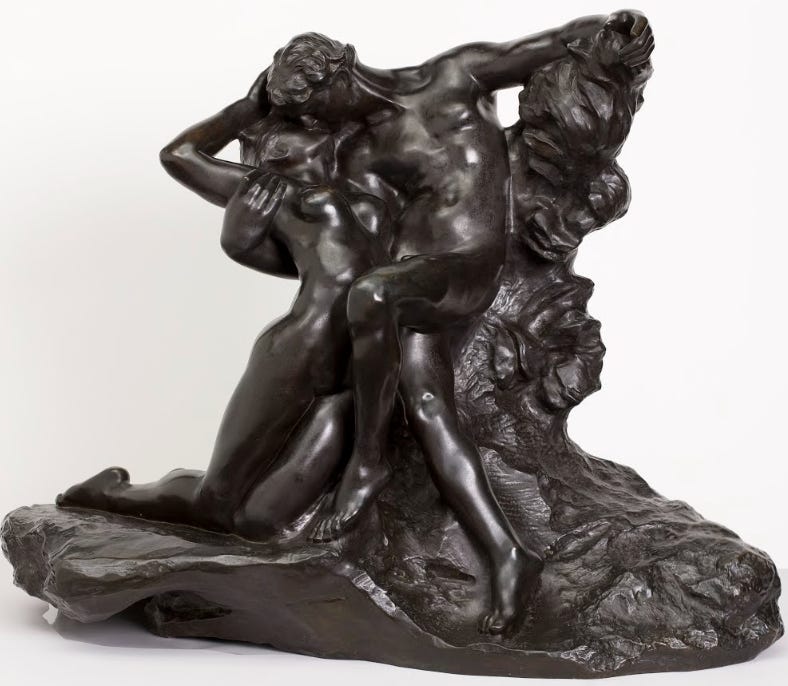
Hitler, architect of destruction, hated Europe -- the Europe that Celan and Zweig loved, the international Europe, the striving, intellectual Europe of art and commerce Zweig depicts through his friendships with figures as diverse as Zionist organizer Theodor Herzl and modernist French sculptor August Rodin. In his epic autofiction Min Kamp, Norwegian writer Karl Ove Knausgaard reads Hitler’s infamous book of the same name (Mein Kampf, My Struggle) and moves into a 450-page essay/aside depicting the first half of Adolf’s life. Here we see the Fuhrer in Vienna, failing to gain admission to art school and then architecture school. After that he falls into life as a broke itinerant selling homemade postcards that he draws depicting sites of the city and scenes from the street. Hitler sleeps at a men’s shelter and longs, more than anything, to belong to the art world. But he lacks both talent and vision. Knowing that he can never achieve his goal is the crux of his early “struggle.”
After serving in World War I, however, Hitler finds a new passion: – unwinding the European project, deconstructing modernism, returning his battered homeland to the values of blood, steel and statis. Hitler’s failure becomes his allure. His naked rage manifests as an urgent desire to be needed, to save. People react to his fanaticism on an unconscious level. Writes Knausgaard:
Anyone who has seen footage of the rallies of Hitler’s Germany knows what feelings they evoke, the sheer might of the uniformed, I-less community, the strength of the collective, and oh, how one might long to be part of such a we. Some of the images of the age express an almost savage beauty.
The savage beauty of “a we”, of how we will be, naked awful awe. Once Hitler conquers Vienna and the war ends, his plan is to usurp the city. He will instead turn Linz, where he grew up, into the Austrian city. Amid his failing war, he commissions a scale model of the new city that features a massive museum of looted art and a giant tower under which his dear mother and father and eventually little Adolf himself will be interred. Late at night, flipping through the stack of books on my night table, I try to remember where I read that The Fuher eventually brings, along with Blondie and Eva Braun, this scale model Linz with him to the Berlin bunker where all will end their days.
I don’t find the source. No matter. The minutes tick past and I’m still wide awake. How to live after a nightmare? Knausgaard agrees with concentration camp survivor and reluctant Montrealer Rosenfarb that Celan is deliberately inscrutable. He writes his claustrophobic poetry as if he was trapped in a language or language in general. He seeks a new language from which to testify, but the dead languages of Europe linger, morphology as power. We still read Kant and Heidegger. We still listen to Hitler’s beloved Wagner. The mythology of purity, of unadulterated beginnings, still churns up in us the supposed glory days, before the Jews wept in Babylon, before Christ died smiling, before the waters muddied and dusky traders moved up and down the coast selling mongrel dogs and half-breed horses the likes of which the people had never seen.
Why? Chava Rosenfarb wonders. Why do these great writers kill themselves after the war? She notes how few acts of suicide there were when she and her family and tens of thousands more were desperately trying to survive the Lodz ghetto then the furnaces of Auschwitz. Rosenfarb charts the similarities of these four artists. Particularly striking to her is how they grew up as relatively wealthy sons in a time when the Jews of Europe were rapidly gentrifying, assimilating. All four thought they could walk away. Walk away from how their parents and grandparents had been. The old assumptions and traditions. Walk away from prayer and exile and poverty. Move to the light of modernism – of art, atheism, and freewheeling acceptance. The great free flowing churn of ideas. They had freedom! They had Europe!
But the anti-Semitism of fin-de-siècle Vienna was never far away. The undercurrent of hate that baptized young Hitler, that set him on his path of scorched earth rage against what he couldn’t be, finally found them -- in Brazil, in America, in the cold winter waters of the Siene. The Europe they believed in was gone. They had left behind their connection to the Jewish world they had once taken for granted and happily forsook. What was left to them now was a netherworld, a gray zone, whispers and faded photos, paranoia, breakdowns, reoccurring memories. They lived “overcome by the sense of being cursed and abandoned,” writes Rosenfarb, though she might just as well have been writing about herself.
Finally, I feel it. The weight of sleep. The book in my hands is suddenly heavy. I scan the passage I’m trying to parse -- one more page and then an end to this interregnum, this time before dawn.
“We were nothing,” Celan prays in his poem “Psalm.”
“We are,
We shall remain, flowering.
The nothing --, the no-one’s rose.”
The connection between leaving behind Jewishness, and suicide, yet their living “overcome by the sense of being cursed and abandoned,” while they chose to abandon what felt so oppressive and unenlightened about Judaism, feels so deeply sad and complicated.
Great post. Makes me want to re-tackle the last volume of Knausgaard's My Struggle. I devoured the first five volumes several years ago, then got stuck on the extended close reading of the Paul Celan poem in the final volume. Will pick it up again. Thanks, also, for introducing me to Rosenfarb. Will look for the book of essays you reference (title?).