

My octogenarian mom sits on the dock, resplendent in leopard print bathing suit, matching wrap, wide brimmed hat and chic sunglasses. She surveys the small lake, her head on a life-guard-like swivel. I emerge from the cool water. “Halli,” Mom says, “Is W. okay?”
W. is my wife, happily swimming across the lake and back, something she does almost every day. I reassure mom that she is fine. No need to send out the search and rescue team, I joke. God forbid, mom says. I head inside to check on dad. He’s fine too, half sleeping, half sudoku-ing. I get a beer, something I do almost every day. When I re-emerge on the porch, Mom is standing at the edge of the dock, agitatedly peering at the opposite shore. “I don’t see her,” she calls up to me dramatically. “Wait. I see her. Halli, she’s not moving!”
I wander back down to the dock. Following my mother’s gaze I pick out the white spot she is staring at. It is, indeed, not moving. I sip my IPA, taste the sour. “That’s a buoy,” I tell mom. “No!” she exclaims, apparently prepared to argue the point. “But where is she then?”
W. pops up out of the darker water to the left of us. “Hi,” she calls merrily.
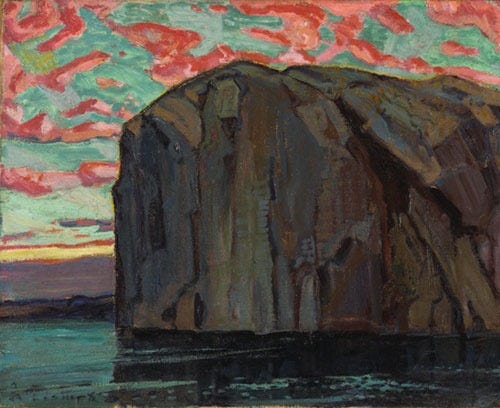
The lake is really a river; its now more bloated contours shaped in the 1800s when loggers constructed a dam to facilitate the movement of lumber downstream. The dam remains, though old growth white pine no longer rolls southward from the dark waters of the Mazinaw, an ancient glacier lake ever unruly in the wind under the watch of its looming cliffside.
Nevertheless, the facts on the ground have only been slightly altered. Our “lake” still flows south and east, part of a post-Pleistocene reshaping dubbed the Mississippi river system, a connected flow of hundreds of lakes, rivers, streams, swamps, dams, waterfalls and rapids. The Mississippi starts at the Mazinaw and concludes its circuitous journey where it meets the Ottawa River, its longer, more magisterial sister, also a product of the ice age, also flowing north to south, from the banks of Lake Timiskaming to the wider expanse of the St. Lawrence seaway.
The Mississippi, flowing past our cottage as a lake, has its disguise abruptly ripped off in the spring. Swelled by snow melt and April rain, it rises rapidly and angrily, throwing off the yoke of civilization to return to barely restrained full throttle ferocity.
Its only wish is to flow, flow and flood, consequences be damned. Thus, it is controlled by a higher body, an authority that opens and closes dams based on, as far as I can tell, the needs of the much more populated lakes, towns and even cities affected further south.
Arriving at our cottage in the spring I never know what to expect: one year, a watercraft safely secured on what I thought was high ground was swept away, never again to be found. Another year, frigid water completely engulfing our dock, front yard and front steps. For this year’s show, the river managed to raise our supposedly impregnable all-season floating dock completely off its massive concrete moorings, spinning this monstrous wooden beast around several times and leaving me to futilely attempt rescue efforts involving everything from a makeshift hitch to a tow rope attached to one of those infernal ATVs. Nothing worked.
Like as the waves make towards the pebbled shore,
So do our minutes hasten to their end;
Each changing place with that which goes before,
In sequent toil all forwards do contend.
There were similar conditions five or six years back, when, as Ricky tells me, his neighbor’s dock was sent floating down the lake under the bridge. Ricky, a still burly man in his mid sixties with a penchant for fast motorcycles and skull tattoos, also lives on our lake-river, though his status as a full-timer confers upon him a certain amount of well-deserved respect. (The Eastern Ontario winter in sparsely populated North Frontenac being neither for the faint of heart nor the casual cottager.) Ricky volunteered to go searching for the dock since, as he put it, “all the neighbors in the bay look out for each other.” The bay being the tiny section of our small lake demarcated by the dam from the Mazinaw on one end and a narrowing on the other end. Ricky wandered over to the most likely landing point, the area just past the narrow’s current, a parcel of land belonging to the first of two trailer park vacation spots.
There Ricky found a fellow by the name of Rudy. Rudy is a summer fixture in the trailer park and on the lake. Rudy, around the same age as Ricky, was assiduously dismantling a wood dock and reforming it into a deck extension for his trailer. Ricky and Rudy had words. In the end, Rudy was forced to compensate the neighbor for his impertinent act of salvage.
The river flows no matter what we mortals do to restrain it. Years go by and Rudy retains a certain level of animosity towards Ricky. It’s personal. This manifests in, among other things, all day fishing expeditions conducted in the bay, Rudy’s boat positioned right in front of Ricky’s house. The spot, Ricky insists, is designed for maximum irritation. Ricky catches Rudy fishing with one rod while another is propped up on the bow. This is a violation of the rules, apparently, a fact Ricky points out when he passes the picture he snaps along to the area’s conservation officer. Said officer drops by Rudy’s trailer to issue a ticket. Rudy, according to Ricky, vows revenge. He’s planning something, Ricky assures me. “What’s he planning?”
It’s now late summer. Kid #2 and I pack a bag. Crackers, apples, salami, chocolate. We load the canoe up on the car and head over to Bon Echo Provincial Park. The main attraction of the park is the Mazinaw and the giant cliff dotted with faint pictographs, getting fainter every year. The red ochre of the thunderbird, Nanabush and Mishipizheu. Once there was world. We were long yet to be born.
We drive to the visitor’s centre where we find Kid #1, who works at the park during the summers. We linger, looking at the animals in their taxidermized finery. I reach out to pet the soft belly of the stuffed black bear. “No touching,” Kid #1 admonishes. I guiltily retreat. Later she’ll complain to her mother: “He’s like a child.”
Then on to Joe Perry Lake. We seek a path through the marsh, our goal to reach the adjoining Pearson Lake then push south to the beginning of the Skootamatta river. After a false start that gets us stuck in the muck trying to turn around, we locate a more promising opening—the one Kid #2 suggested we take in the first place. “I told you,”She says triumphantly when, after thirty minutes or so, we break back into open water.
It’s a perfect day, cool but sunny. I consult the map and guide us west. We pass abandoned campsites and thick bush. We reach a rock outcropping of tangled trees, an island of sorts. The lake narrows as we move around the eerie obstacleI feel the pull of the river. “Paddling in rivers is different,” I suggest to Kid #2. “It’s more addictive. You just want to keep going and going.”
On the other side of the island, we hear splashing. We rest our paddles and search for the source of the sound. “There,” Kid #2 points. There are three river otters, diving and dancing in the water. Seeing us seeing them, they stop playing and stare. We approach slowly and they retreat, popping up to measure our progress, our intentions.
After some fifteen minutes or so of the otters diving, disappearing and reappearing, we come to a darker turn of overhanging trees and swamp. Here the otters make their stand. The biggest of them hisses angrily at our approaching canoe and the two smaller jump up out of the water repeatedly, as if trying to make themselves larger, more menacing. “Okay, okay,” I mutter. We paddle slowly backward. This is their home. We are just guests. Not even invited.
Ricky comes over to tell us that Rudy has made his next move. It’s a bold one. Rudy has had a large flag made. He motors over to Ricky’s bay and unfurls it in the steady breeze.
The flag bears a motto. Ricky is incredulous. Bright orange letters.
“I’m Rudy. I Do Rudy Things.”
Impressive. Your move, Ricky.
further reading from the memoir series:
Summer Ends

I am back in the city after stretch of time spent in Northeastern Ontario. Our summer place is in a quiet area, sparsely populated. The loosely scattered tiny towns compensate for their decline and neglect with plantings of hardy tiger lily in front of the post office, and bingo at the Lion’s Club. I love passing slowly through them on my way to and fro…