

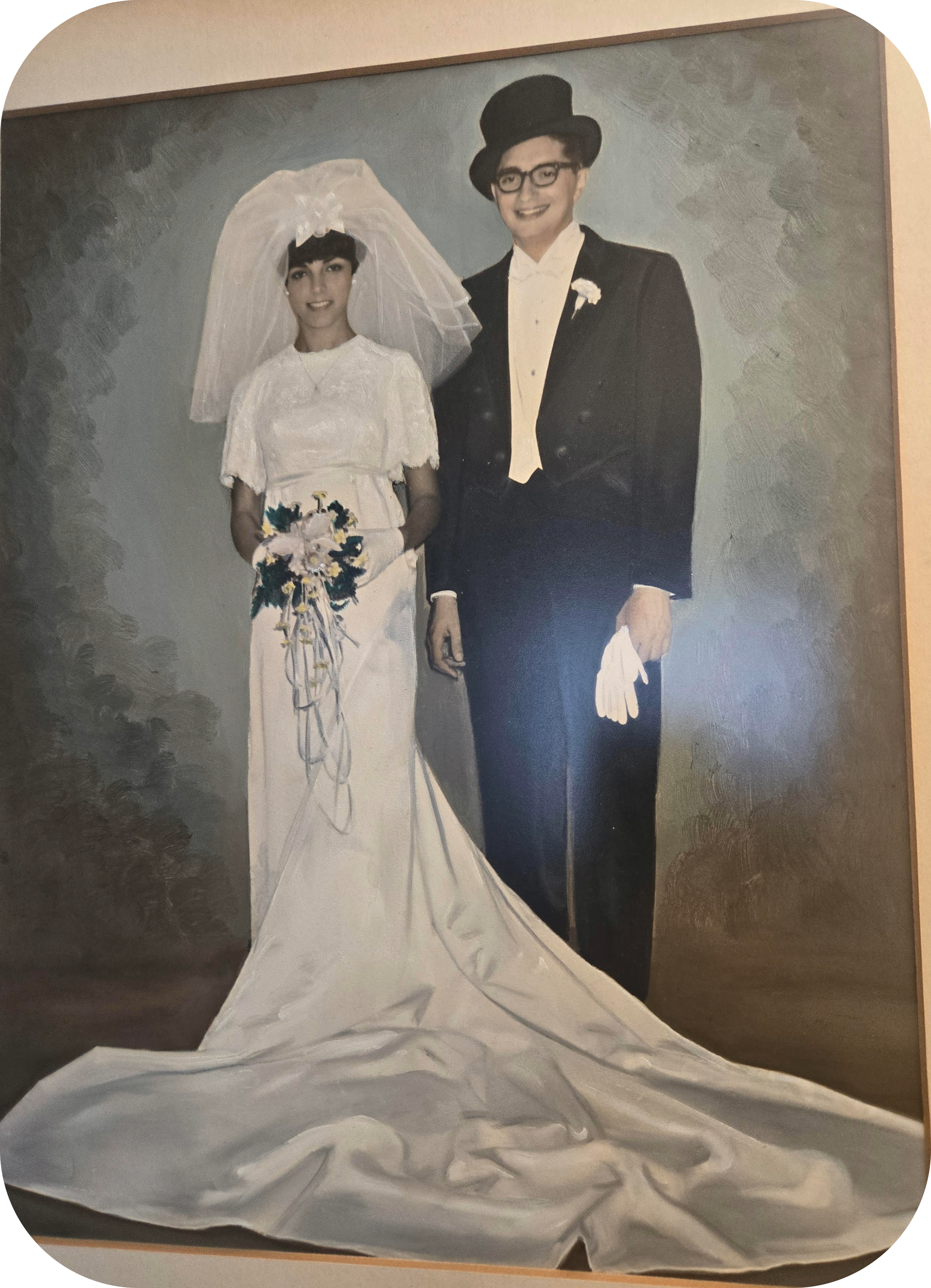
My parents are celebrating their fifty-ninth wedding anniversary. We offer to have them over for dinner, but they want to do their own thing — a romantic outing at a restaurant, just the two of them. The only problem is: where to go?
I offer suggestions. Over cheap sushi, my parents report back to me.
“Hallie,” my mom says, “I looked at that one place you said and it is one-hundred-and-twenty dollars per person to go there.” I stifle a laugh. That might have sounded like a lot when they got married in 1966, but these days that’s on the low-end for a fancy dinner in Toronto. Anyway, after long years working hard at successful careers, they certainly have the money. In their eighties and coming off a hellish year that saw my Dad undergo and recover from jaw replacement surgery, if there is ever an occasion to splurge, wouldn’t this be it?
I turn to my father. Did he perchance look into anywhere to take his beloved? “Why bother!” he blurts loudly. “She won’t like it anyway! So why bother?”
Oh-kay.
“There is a new place near us,” my mother announces. “We will go there. It is Indonesian food.”
My father splutters on his green tea.
“I’m not eating there!” he yells. “Indonesian food? What in the hell is she talking about? Indonesian food?”
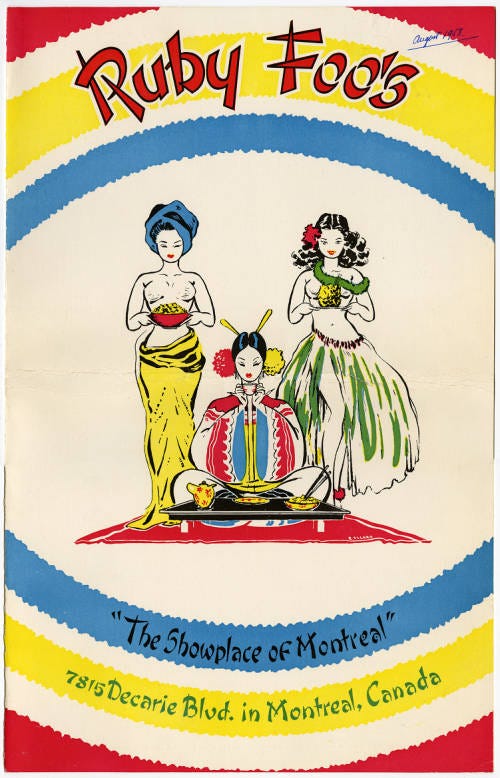
My parents’ first date is at the Montreal restaurant Ruby Foos. A success ever since it opened on Decarie Avenue to great fanfare in 1945, it is still a very popular, very classy spot in the early 1960s when my father meets my mother at a Jewish social club for youth. At the time, it is famous for serving what would today be considered a bastardized mix of Chinese and Western food. In the provincial, Catholic, Quebec of the 1950s era, however, this is considered both exotic and classy. The restaurant is a huge hit, attracting English-Protestant playboys, emerging French Catholic titans of banking and real estate, and the old-school Jewish clothing factory barons.
The restaurant is situated in the nouveau Jewish area, across the “street” (a vast swathe of underground/overground highway) from another Montreal icon, the famous Orange Julep. This is a fast-food restaurant encased inside a wooden “orange” so massive it’s visible from miles away. Here the French girls on roller skates serve hotdogs smothered in beefy spaghetti sauce (a flavour imported from nearby Plattsburgh, New York). Customers sit in their cars. They don’t even have to get out to order.
When I was a kid, I used to love going there as part of a visit my grandparents who lived just down the street. To me, that was the height of luxury. But for my mother, Ruby Foo’s would have been next level. Coming from a poor refugee family that arrived in Montreal from the far regions of the Soviet Union in the mid-fifties, any dining out would have been considered opulent, let alone a trip to one of the hottest night spots in town.
If they were lucky, my parents would have sat in one of the quiet, spacious, luxurious banquette booths upholstered with deep red vinyl. They likely wouldn’t have noticed, but those highly visible booths were the most coveted spots in the joint. Many a crooked politician or cop wined, dined, winked and eyeballed from those tables, always on the lookout for, as one noted commentator on the Fifties Montreal scene wrote, “potential purveyors of graft.”
The menu would have tempted my parents with such strange delicacies as pineapple chicken aka Bo Lo Guy Pan for $1.30 and sweet and sour spareribs for $1.35 (pork, but that was okay, so long as you didn’t bring the leftovers home or tell your parents). For those looking for something classier, why not a lobster thermidor for $2.50? Chop suey came with the relatively unknown fragrance of ginger, fried rice was darkened by soya sauce and speckled with luminous green peas and bright cubes of carrot. Egg rolls, of course, but also the newly fashionable Club Sandwich and Fries.
I always imagined Ruby Foo’s to be one of those weirdly unique Montreal phenomena, like Moishe’s, the iconic steak house. Moishe’s was the brainchild of a pre-war Romanian Jew who mixed old world flavours with North American tastes to create an enduringly unique sensation; a hybrid of smells and sensibilities and spices that lives on today in the recipes of restaurants ranging from upstart suburban Smoked Meat Pete’s to Shwartz’s to Joe Beef and even the recent corporate reboot of Moishe’s Steakhouse itself.
But the Ruby Foo story is more complicated. Ruby Foo is in fact an American phenomenon. She is an actual historical figure, one of the first ever successful Chinese American woman entrepreneurs. Born Ruby Foo Wong in 1908, she comes of age in a teeming, openly racist boomtown San Francisco built on the backs of the badly treated Chinese “coolies”, cheap labour imported to build the railways that would gradually come to crisscross the US.
Barely twenty, Ruby Foo moves to Boston and opens a one room restaurant. Harnessing her canny instincts as a first-generation Chinese American restauranteur, she soon expands, opening the much larger Ruby Foo’s Den in Boston in 1929. Its blend of deliberately cheesy Oriental mystique, genuine Asian cuisine, Western offerings, and an extensive list of champagne cocktails, is a hit. It’s the first “Chinese” restaurant in Boston’s Chinatown to attract a primarily white clientele, and from the better classes to boot. Ruby Foo Wong isn’t done. She goes ahead and lends the formula, her unique brand, to restauranteurs in some of the grandest cities of the new world: New York, Miami and, of course, Montreal.
The exact nature of Ruby’s business dealings in Montreal are obscured by time, fate and, as it turns out, illegality. When you are doing deals with gangsters, record keeping is often vague, even nonexistent. We do know is that Ruby Foo’s Decarie opens its doors in 1945. Its most visible owner in what seems to have been a lucrative partnership is one Max Shapiro, Jewish immigrant from the Polish shtetl with a head for numbers and, like a small but influential cohort of his fellow co-religionists, little concern with the laws of the day. In fact, much of the Montreal criminal scene in the pre-World War Two environment comes from the ranks of Jewish immigrants from Romania, Poland, Lithuania and other outposts of besieged, already-fading Yiddish speaking Jewry.
After making his way to Montreal sometime in the 1920s, Shapiro gets in with the bigger Jewish and Italian players, most notably the infamous Harry Davis, also a Eastern European Jewish immigrant. Davis, at the time, is Montreal’s head mobster. He alone decides who can and who cannot dabble in illegal gambling in the city. With Davis’ blessing, Shapiro is allowed to establish himself. First, he must see where opportunity lies. The wide-ranging gambling scene includes everything from supposedly banned slot machines in the Laurentian resorts, to basement dens offering the French longshoreman’s dice game barbotte. Gambling is everywhere. The Catholic church, which presides over most of the social fabric of the day, is publicly very much opposed. So are the politicians and police, who launch frequent raids but never seem to find anyone of import to arrest.
Shapiro opens a gambling parlour on Peel Street. Still today, the Peel strip is known as a place of revelry and hedonistic excess – sin times ten. Take a stroll down its brightly façade on a Saturday night and you’ll find clubs and pubs and beer halls drawing everyone from rowdy McGill students to party hopping tourists to suburban Montrealers come downtown for a taste of the city’s famous nightlife. But things are more conservative at the time, and pressure is mounting to clamp down on what one magazine dubbed “the most lawless city in North America.” Maybe that’s why Shapiro also decides to invest in the more legit Montreal Ruby Foo’s.
A year after Ruby Foo’s opens, Harry Davis gets shot in the stomach three times by low level thug Louis Bercovitch. This turns out to be the end of an era. Bercovitch’s blatant act of violence – retribution for Davis denying him permission to open his own gambling den – shocks Montreal. The city finally gets serious about cleaning up its gambling dens. Shapiro is thanking his lucky stars. He got out just in time.
I don’t know if Ruby ever visited Ruby Foo’s Montreal or had any knowledge of the unsavory aspects of its first ownership group. Foo died not that long after the Montreal branch opened. Still in her forties, a heart attack took her in 1950. She left behind an expansive empire, two ex-husbands, one current husband, and three children. Shapiro also died abruptly of a heart attack in 1958. Was it something in the food? Shapiro’s twin sons took over the restaurant but sold it off in relatively short order. Like so many offspring of the Jewish gangsters from a wilder era, the Shapiros went straight and went brilliant. They both attended McGill and became, respectively, the Presidents of McGill and Princeton in their later years.
Though Max Shapiro often “held court” at his successful Ruby Foo’s, he was dead well before my parents’ first date. I doubt my future mother and father knew much of anything at all about the Jewish mob ties behind the popular Montreal franchise. I doubt they even knew it was a franchise. They were too busy mooning at each other, holding hands, talking about their plans. The future lay before them, a seemingly bright and unexplored expanse. My father, like the Shapiro sons, would soon go to McGill, part of a large wave of Montreal Jews who were freed to attend by the trailing away of Jewish quotas and blatant institutional antisemitism. My mother was graduating Baron Byng high school and starting her own remarkable career, first stop a secretarial position at a local law firm.
In 1966, my parents would marry. They would leave Montreal forever a year later, never to live there again. Like Ruby Foo, they were immigrants who sought new pastures where they could leave behind old prejudices and stake new claims. Like Max Shapiro, they endured, worked, strived, scraped — all the while seeking a better, less fraught life for their two sons.
“Preferred by the town’s most interesting people,” Ruby Foo’s newspaper ads said. The gossip columns didn’t notice these two “interesting” young people, teenagers shyly perusing a menu as thick as a short book while peering through clouds of cigarette smoke at the hoi polloi of Montreal’s glory days. Nevertheless, they were there. Two people, two incredible stories, two long journeys at an end. A new beginning at the fanciest joint in town.
My great-grandfather was Max Shapiro. My son Max is named after Max Shapiro. My Nana Molly (Shapiro) Cohen was his daughter from his 1st marriage, born in 1913 in Odessa, Ukraine. Bernard & Harold Shapiro were born to his 2nd wife in Montreal in 1935.
Your article was very evocative for me. Many family events were celebrated at Ruby Foos by us too, even after the business was sold.
Thank you for writing this article. I enjoyed it & will pass it on to my mom, uncle, great uncles & cousins. Cheers!