

In the middle of summer W. and I drive four hours north. It’s a long way to go for a three-hour camp visiting day, I suggest to her. The comment earns me an incredulous, almost pitying, look. I quickly turn up the radio. The news comes on – the Gaza war, now in its second year – grinding endless conflict.
Kid #2 is at a new camp this summer, having aged out of her previous, much closer locale. This year the kids sleep in tents without supervising counsellors. They do a much wider range of activities. In addition to the usual colour wars, canoeing, shirah (song), rikud (dance), and marathon bead-making sessions, they talk about their feelings and their relationship to their Judaism. They do leadership activities. They hug a lot.
Upon arrival the first thing you notice is a security guard complete with bullet proof vest. There’s a fancy gate that blocks the camp road. This is a summer camp. A Jewish one.
The school bus we boarded in the local town lets us off in the camp sports field. Campers surge forward as if from a burst dam. Standing off to the side observing while W. plunges into the crowd to search for Kid #2, I notice that it’s hard to tell the campers – 14 and 15 – apart from the counsellors – 18 and 19. Later we’ll take a picture that shows Kid #2 several inches taller than her university aged “tent mother”. My once cherubic perma-toddler suddenly grown up.
The first item on the agenda is mifkad (flagpole), the morning ceremony at which announcements are made, the Canadian and Israeli flags are raised, and O, Canada is sung. After we sing the national anthem, the kids recite in Hebrew what sounds to me like a prayer. The wind from the lake blows through the surrounding bristle of conifers. Many kids and parents, having just reunited, are still excitedly talking to each other, unable to contain themselves. I can’t catch the prayer. “What was that song?” I ask Kid #2 when it’s over. She shrugs. “It’s just some prayer. We say it every morning.”
Later, I get a chance to circle back to the flagpole area. Here are posted the words of the sung prayer in Hebrew and translated English: “If I forget you Oh Jerusalem, let my right had wither….” It’s a song adapted, as far as I can tell, from the famous Psalm 137 of the Jewish bible. This psalm commemorates one of the most painful moments of ancient Jewish history. The year is 586 BCE and Judea, the Jewish kingdom, is invaded and destroyed by The Babylonians, who exile the Jewish people to the far reaches of empire. The first temple, built with the wood painstakingly carried by the Jews through the desert after their escape from Egyptian slavery, is destroyed.
This tragic event, one of so many others to come, is marked by a day of fasting and lamentation known as Tisha B’Av. Tisha B'Av (the ninth day of the Hebrew month of Av, falling in July or August) also marks the destruction of the second temple in 70 CE, this time at the hands of the Romans. Again, the Jews experience a forced dispersal – deliberately scattered throughout the far outposts of Roman territory. (A theme, one could say.) Tisha B’Av is also notable as the sole somber day at many Jewish summer camps. Girls hug each other tearfully and boys stare manfully into the forest. The camp’s most soulfully bearded guitarist strums the melody to “Yersushaliem Shell Zahav” (“Jerusalem of Gold”).
I’m found in the mifkad area. Kid #2 reprimands me: No unsupervised wandering. “Who did you talk to? Don’t talk to anyone!”
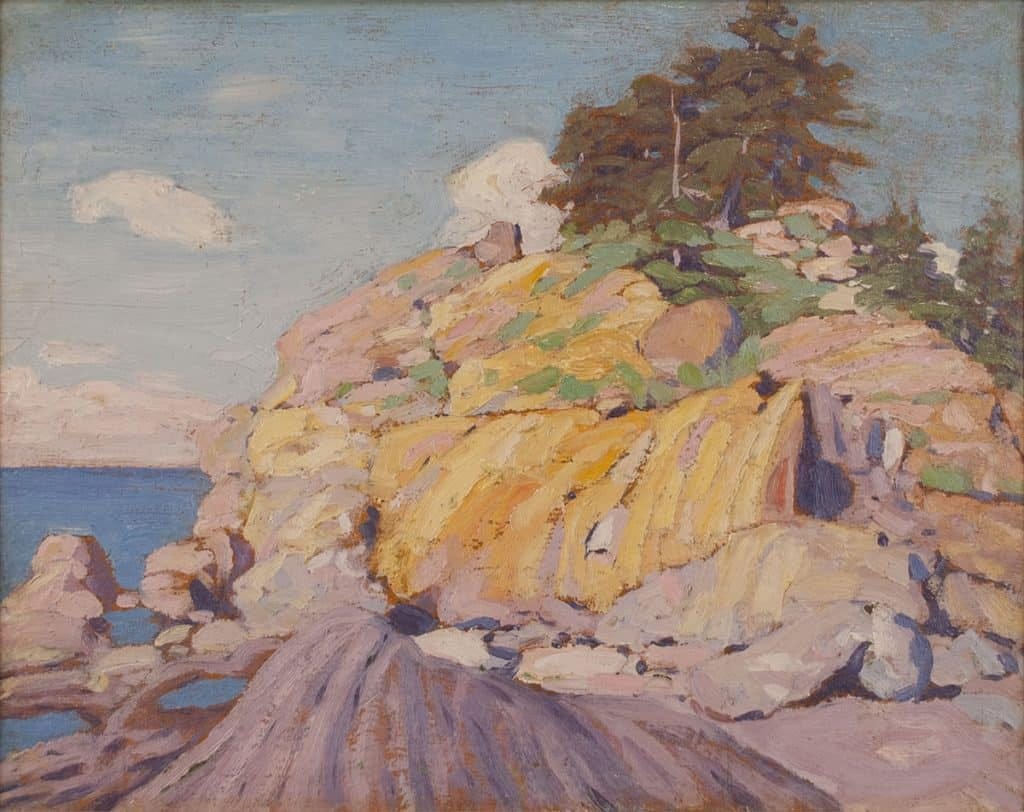
We eat our barbecue lunch on the rocks overlooking the water. The wind has settled, and the lake is still. Kid #2 and her mother chat excitedly about the camp’s various doings. All around us are similar scenes, kids and parents happy to be together. Camp is on a bay at the end of a mid-sized lake. I watch the water lap at the beachfront. The sun is high in a cloudless blue sky, but slowly inexorably sinking. Soon it will be time to go. I am surprised to discover that I don’t want to go. “I like it here,” I tell my family decisively. “Not so loud,” Kid #2 hisses.
Before the buses arrive to take us back to our cars, the campers and counsellors show us their famous ruach. They sing the camp song at the top of their voices complete with furious moshing. Kid #2 is right near the middle, waving her arms in the air and bellowing the words in Hebrew and English (Hebglish!). Parents frantically snap pictures. It’s a Grateful Dead-Taylor Swift mashup staged in the middle of nowhere for the benefit of almost no one.
And then it’s over. Kid #2, a faint sheen of sweat over her tanned face, shoos us onto the bus. “See ya,” she says, dolling out quick hugs, her smile showing a hint of relief. As the buses pull out, she puts an around her bestie and tentmate, who waves desperately at her parents then bursts into tears.
The hot sticky school bus lurches away. I open the window. Northern Ontario pine and the lingering scent of grilled hot dog rush over me. So, too, does one more line from Psalm 137: “How can we sing the songs of the Lord in a strange land?”
A well-wrought survey of camp life these days...but I could not help overlay my Catholic church camp experience of 60-odd years ago. Such a careful time of man we live in now compared to then. Alas.
How is it that all Jewish summer camps are so uncannily similar regardless of where they are located? I'm jealous about visiting day, though. The camps my kids attend/ed never offered one (which, I'm not complaining about not having to make the long drives, but my kids have never been great about making it into the camp photos posted online, so proof of life becomes extra important).
We're in Israel right now on a family trip we've been trying to take since 2020. Yesterday, Tisha B'Av, we were on a day long tour with a family friend who works as a tour guide. We did some archaeology, crawled 45 minutes through a dark cave that isn't yet open to the public, and then, after lunch, visited some spots in the Gaza envelope -- Sderot, where a local talked to us about the town's history and its music scene and what happened there on October 7. Then we drove to the site of the Nova music festival, and finally the lot where dozens of burned out cars from that day are arranged in a sort of junkyard/ cemetery/memorial. It didn't take much to evoke mournful feelings, even though we weren't fasting or praying.