

In 1938, the noose was literally tightening around the necks of the Jews of Europe. Concentration camps had been established in Germany. The NAZIs had annexed Austria and a section of Czechoslovakia. They were hungrily eyeing Poland, all while pledging to cull the “parasite” Jews and restore racial purity to their expanding empire. European leaders, desperate to stave off another war, sought to appease the increasingly militaristic Third Reich, while the USA and Canada murmured polite nothings about Hitler’s, perhaps, just a tad extreme policies.
Meanwhile, evidence was reaching Canada and the world that Germany’s new nationalism steeped in the emerging “science” of eugenics was more than just rhetoric. It was a core principle of the Reich. War was in the air and, as usual, Jewish people were likely going to be the first to be dragged into the maelstrom—as collateral damage, or worse. Then, a flicker of hope: America’s President Roosevelt announces a world conference aimed to meet the crisis of the planned expulsion of every Jew from Nazi territory.
Hurriedly, Canadian Jewish leaders gathered to formulate what they hoped could be Canada’s contribution to rescuing the Jews now trapped behind enemy lines. They were, at the time, optimistic about Canada’s willingness to help. Canada, an increasingly wealthy and relatively tolerant country had, if anything, an underpopulation problem. It was vast and, in comparison to European countries, largely empty. Meanwhile, the Jewish people of Germany and Austria were among the most educated, skilled people in the world. In the hundred years or so prior, Canada had admitted mostly Eastern European Jewish refugees, many of which had come to the country with nothing. They had nevertheless succeeded. Settling in cities across the country, most notably Montreal and Toronto, they had worked hard to better themselves and integrate into society. And though there were still conscriptions against their presence in certain professions, social clubs and universities, Jewish intellectual and economic activity had unequivocally advanced and enriched the country. Hospitals and schools were founded, iconic businesses were established employing hundreds then thousands, and all the while crimes such as attacks on synagogues or Jewish schools were nonexistent. Jewish people went about their business unbothered, no armed guards necessary. The European Jews at risk overseas were smart, talented, worldly and would no doubt take even less time than their predecessors to contribute to the still young country of Canada.
A month before the July conference to be held in the gorgeous French Alps town of Evian, the Jewish dignitaries arrived in Ottawa. The group brought a proposal that had been very carefully calibrated for success. Write the historians Irving Abella and Harold Troper in their indispensable book None is Too Many: Canada and the Jews of Europe 1933–1948: “It was a modest, workable refugee scheme; they were convinced it would be acceptable to the cabinet.”
The plan was, indeed, extremely modest. It asked for only 5000 refugees to be accepted into the country out of an estimated 150,000 to 200,000 frantically looking for a way out of Nazi territory. No money would be required from any level of government. Every single refugee would be fully taken care of by the Jewish community. Finally, no refugees would be allowed to settle in Quebec, even though Montreal was second only to New York City as a centre of Jewish culture in North America at that time. This latter point, however, was deemed essential. It was meant to forestall French Catholic objection, thereby allaying ruling Liberal party fears that they might lose some fraction of the Quebec vote if the plan went ahead.
Despite its modest ambitions, the proposal was never considered. The most important official on the committee skipped the presentation altogether. The endorsement by Prime Minister McKenzie King that back channels had primed the Jewish delegation to expect never came.
Then it was July in Evian. Hearty proclamations were uttered by the 32 countries in attendance. Delegates and attachés enjoyed the region’s splendorous spas, trails, and cuisine de terroir—all top-notch. But by the end of the week, neither Canada nor any other country had agreed to take even a tiny portion of the hundreds of thousands of Jewish people Germany was eager to expel in their efforts to make their expanding territory judenrien. The conference concluded with the Germans issuing a smug statement noting that the entire world was criticizing them for trying to expel their Jews, but nobody else wanted them either.
By the fall, emboldened NAZI rhetoric would escalate into pogroms, slave labour and extermination. War broke out. Jewish Canada supported the war effort in every way they could, out of patriotism, hate for Hitler and in the hopes that vocal support for the war might help sway the government on the matter of refugees. Organizations like the Canadian Jewish Congress sent delegation after delegation of important representatives to Ottawa. They arrived with the latest modest hush-hush plan. Please we could bring in, perhaps, maybe just women and children? Or how about just orphans? Orphans with Canadian relatives? What if they were admitted just temporarily, if they promised to leave as soon as the war concluded? The numbers of Jewish refugees proposed kept shrinking even as the number of Jewish people at risk expanded exponentially. The German Jews had gone silent. No one knew their fate. But what about the rumours swirling around the disappearances of entire shtetls as the Nazis swept through Poland, Galicia and Eastward? Surely benevolent Canada would allow its citizens to do something, however modest, for them?
But the proposals were met with nothing more than shrugs. Even the wealthiest and most well-connected Jewish Canadians could not receive special exemptions from the ironclad rules. Not for siblings, parents, children, or anyone else. The increasingly desperate situations of millionaire industrialists, genius inventors, accomplished surgeons, acclaimed playwrights and poets, not to mention countless orphaned children, were all put before the political class and its bureaucracy. Canada refused to budge. None was too many. As Abella and Topper put it: “Quiet diplomacy had failed”.
The failure of Jewish leaders to influence the Canadian ruling class went beyond policy. With the war nearing its tragic denouement, the Canadian populace was somehow less disposed to Jewish people than they had been before Hitler’s genocidal mania spread through Europe. Gallup polls in 1944 showed record disapproval from Canadians regarding “refugees” aka Jews coming to the country. In Quebec, the idea that refugee Jews might be coming was used to hammer the governing Liberal party and its collaborators in the province. Maurice Duplessis, former premier and then leader of the Union Nationale opposition, went to a village church in the pastoral heartland of Dorchester County and flamboyantly waved a piece of paper. Here, he claimed, was written an insidious plan, an agreement between the Liberal government and the “International Zionist Brotherhood”. The “Brotherhood”, a group he’d entirely concocted, would supply millions of dollars of dirty money to get Liberal candidates elected. In return, 100,000 Jewish refugees would be turned loose in la belle provence.
The hundred thousand never came. Not even close. By war’s end, only around 5000 Jewish refugees had been admitted to the entire country. Again and again, the Jewish powerbrokers had come to Ottawa and returned empty-handed. Again and again, these same powerbrokers promised angry communities and desperate relatives that the government was softening. If they could just wait a little longer. Have patience. Don’t do anything rash. Calls for protest rallies, walkouts, strikes, petitions and sit-ins were all dismissed. Counterproductive to the cause. Don’t make a scene. Don’t give the enemy more reasons to hate us. “There was a fear that resonated through most of the [Canadian Jewish] leadership that any emphasis on the genocide of the Jews would cause public opinion to look at Canadian Jews as being interested solely in Jewish problems,” is how Montreal scholar Max Beer put it while presenting a paper on the subject in 2012. But the scheme of relying on Canadian solidarity, morality and goodwill turned out to be an absolute and total failure. By the end of World War II, Canadian Jewry’s representatives had still not been able to convince the government to bring in any of Europe’s now stateless, decimated Jews. And though the war was over, the situation remained precarious. Jews who had dared to go back to their prior homes were being hunted and murdered all over again. As a result, a quarter million Jewish survivors sat, shell-shocked and stunned, in displaced person camps formed by the allies throughout Europe.
In 1944, “yet another Jewish delegation arrived in Ottawa,” wrote Abella and Topper. This one was led by the esteemed Samuel Bronfman, the Seagram’s multimillionaire who had taken over the presidency of the Canadian Jewish Congress in 1939. The group arrived bearing all the usual arguments about orphaned children, desperate widows and the willingness of Canadian Jewry to pay every and all costs. But the only thing that seemed to catch the interest of the decisionmakers was a hastily developed scheme about a supposedly critical shortage of skilled workers in the largely Jewish owned Canadian garment industry. Where could such workers be found? Why it just so happened that Jewish tailors and seamstresses were now pouring into those very same displaced persons camps.
The idea was a band-aid on a gaping wound. A few thousand Jews were eventually admitted under the “tailors” program reluctantly agreed to by the Canadian government. (Some of the admitted, including my grandfather, were rumoured to have been hastily taught to work a sewing machine by an advance corps of Jewish Canadian aid workers.) Another six thousand from these postwar camps were eventually admitted into the country over the next few years, but only after their Canadian relatives were able to find them and promise to support them. In total, Canada found room for no more than 13,000 European Jews over the course of the long, deadly decade. This was almost as many men, women and children who were being murdered every single day at the peak of Germany’s Final Solution
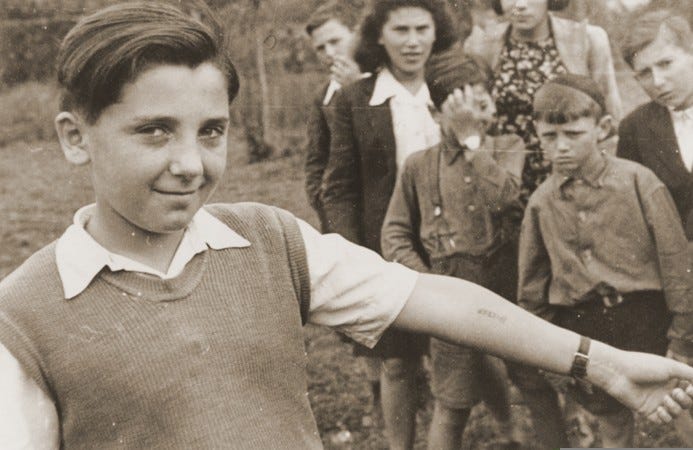
In April 1945, the mad king Hitler poisoned his girlfriend, his pet dog and, finally, himself, bringing an end to the war and his enthusiastically embraced project of eliminating all Jewish people in Nazi territory. Six million men, women and children had, by then, been shot, gassed or starved to death. With the war over, George Vanier, Canada’s ambassador to France, joined a fact-finding tour of the German concentration camp Buchenwald. The group arrived only weeks after it had been liberated by US soldiers. Vanier, one day to become the first French-Canadian Governor General of Canada, a military man who wore a jaunty mustache over an insouciant grin, was horrified by what he saw. The communique he sent on to the Canadian government told of crematoriums, gas chambers and “naked bodies piled like so much cord wood.” Bodies destined for the ovens before the Allies arrived and interrupted the work.
Days later, Vanier filed a report with the Canadian Broadcasting Corporation (CBC) about what he had discovered. It came over the airwaves with the scratchy, far away tone radio voices had then—ghostly, dissolute sounds from across an ocean of space and time. To the listening Canadians what he was saying must have seemed like something from another world altogether. After sombrely describing the concentration camp itself, he moved on to the few survivors, a group he described as so emaciated that it pained them to sit or lie down. Among them were children as young as ten who had spent years making munitions and slowly starving to death. Where were there parents? Vanier wondered. Was anyone left to help these children?
Vanier, having seen with his own eyes what had happened, knew that there was no one left. This was, he noted, not just a war crime perpetrated by the Nazis, but a stain on all of humanity. “How deaf we were then to cruelty and the cries of pain which came to our ears,” he told a shocked, saddened nation.
More Like This from Hal’s archives:
Freud's Theory of the Jews

In 1937, Hitler and the NAZIs are consolidating power in the Third Reich and preparing to swallow neighboring Austria whole. Meanwhile, famous Viennese neurologist and father of modern psychology Sigmund Freud is releasing a final original work. The book, in three parts, is called
To paraphrase Vanier, “How deaf they are NOW…”